
Gold has a strange relationship with sustainability.
On one hand, it is almost perfectly recyclable. Gold does not rust, degrade or lose its essential properties when melted down and reused. A ring made today could theoretically contain gold mined hundreds — or even thousands — of years ago.
On the other hand, producing new gold can be extremely resource-intensive.
To recover a relatively small amount of gold, mines may need to move and process hundreds of tonnes of rock. That means energy, water, heavy machinery, tailings, land disturbance and, in poorly managed operations, serious environmental and social damage.
So when a jewellery brand describes its gold as “sustainable”, what does that actually mean? The answer is more complicated than choosing between recycled gold and mined gold.
Gold has two very different starting points
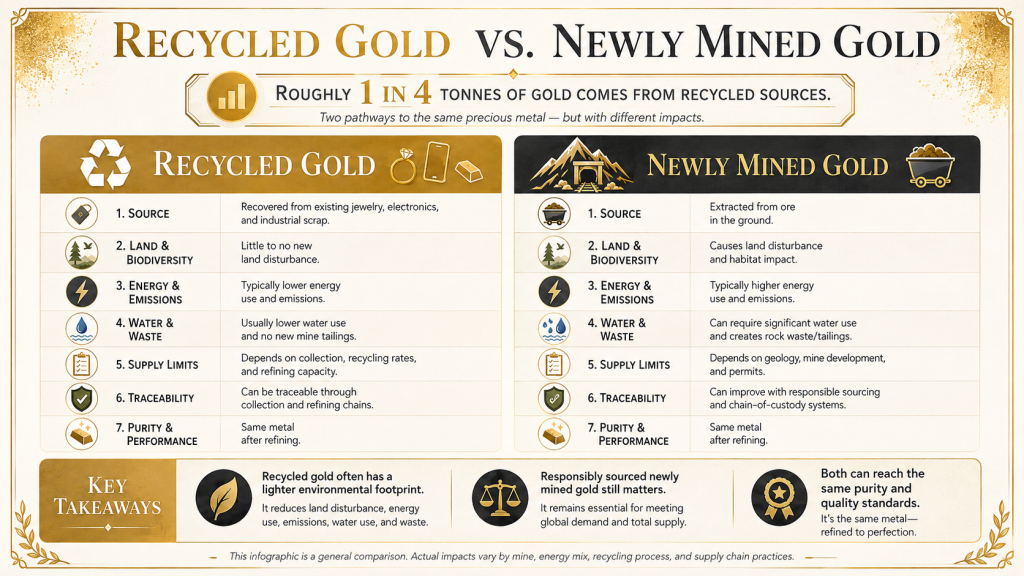
Most gold entering the market each year comes from one of two places. It is either newly mined or recycled from gold that already exists. That distinction matters enormously.
Newly mined gold begins underground. Ore must be extracted, transported, crushed, processed and refined before the tiny amount of gold inside can be recovered.
Recycled gold starts much further along the journey. It might come from an old wedding ring, a broken necklace, investment gold or electronic equipment. Once collected and refined, it can return to the market as chemically identical gold.
There is no meaningful quality penalty for using recycled gold. That immediately raises an obvious question. If we already have so much gold above ground, why mine more?
Recycling has a huge environmental advantage
The environmental case for recycled gold is strong. Mining is energy-intensive largely because gold occurs in such small concentrations in rock. Imagine a mine containing two grams of gold per tonne of ore. To obtain one kilogram of gold, the mine would theoretically need to process around 500 tonnes of ore, even before considering processing losses or the additional waste rock that may need to be removed.
Recycling avoids almost all of that.
There is no new open pit to excavate. No hundreds of tonnes of ore to crush. No new tailings facility created simply to recover that kilogram of gold.
Refining recycled gold still requires energy and chemicals, but its environmental footprint can be dramatically lower than that of primary mining.
From a purely environmental point of view, genuine post-consumer recycled gold is difficult to beat.
But even here, things are not quite as simple as they first appear.
Not all recycled gold is equally recycled
Imagine gold being mined, refined and sent to a jewellery manufacturer. During manufacturing, some gold is left over as offcuts, filings and scrap. That material is collected, returned to a refinery and melted again. It can now technically be described as recycled gold. But environmentally, very little has changed. The gold may have left the mine only months earlier.
Compare that with a necklace worn for 40 years, sold back to a jeweller and refined into a new piece. Both can enter a recycled supply chain. Their circularity story is very different.
This is why terms such as post-consumer recycled gold matter. They tell us more about whether recycling is actually displacing demand for newly mined material rather than simply circulating production scrap within the jewellery industry.
So should we stop mining gold?
This is where the debate becomes more interesting. It is tempting to conclude that recycled gold is good and mined gold is bad. But that leaves an important question unanswered: What happens to the people and communities that currently depend on gold mining?
Gold mining supports livelihoods around the world, particularly through artisanal and small-scale mining. Simply reducing demand without improving mining practices does not automatically solve problems such as unsafe working conditions, mercury pollution or weak community protections.
Some organisations therefore argue that a sustainable gold market needs to do two things at the same time: reduce unnecessary new extraction and make the mining that continues significantly better. That means using recycled gold wherever practical while also supporting mines that improve environmental practices, worker safety, traceability and community outcomes.
A mine can become cleaner — but it cannot become impact-free
There is a major difference between responsible mining and no mining at all.
A better-run mine can switch from fossil-fuel electricity to renewable power. It can electrify machinery. It can recycle water. It can improve tailings management. It can reduce or eliminate mercury use. It can rehabilitate ecosystems after mining. All of these measures matter.
But even the world’s best-managed gold mine still has to reach the gold underground. Rock must still be removed. Ore must still be processed. Land is still disturbed. Tailings are still created. That is why recycled gold has a structural environmental advantage that responsible mining cannot completely eliminate. Responsible mining is about reducing and managing impact. Recycling is largely about avoiding the extraction stage altogether.
This is where certifications enter the picture
For consumers, understanding all of this would be almost impossible if every jewellery purchase required investigating individual mines and refiners.
That is where standards and certifications can help.
But they can also make things confusing.
Fairmined and Fairtrade Gold focus particularly on improving conditions in artisanal and small-scale mining.
The Responsible Jewellery Council works across the jewellery supply chain and includes standards around responsible sourcing and traceability.
The London Bullion Market Association sets responsible-sourcing requirements for major refiners.
The World Gold Council’s Responsible Gold Mining Principles cover environmental, social and governance practices at large-scale gold mines.
IRMA independently assesses mines against a broad range of environmental and social criteria.
Each system tackles a slightly different part of the problem.
So a piece of gold can be “responsibly sourced” without necessarily having a particularly low carbon footprint.
And gold can have a very low environmental footprint without carrying a consumer-facing sustainability certificate.
The label alone rarely tells the whole story.
What should sustainable gold actually mean?
Perhaps the problem is the word itself.
“Sustainable gold” sounds like a clearly defined category.
It is not.
Instead, gold sits on a spectrum. At one end are poorly managed mines with high emissions, significant ecosystem damage and weak social safeguards. At the other are existing gold products recovered from society and refined efficiently using low-carbon energy. Between them are increasingly responsible mines, certified artisanal producers, traceable supply chains and various forms of recycled gold.
The more useful question is therefore not: Is this gold sustainable? It is:How much better is this gold than the alternative?
Where did it come from? How much new extraction did it require? How much energy and water were used? How were workers and communities treated? Can its origin be verified?
Those questions tell us much more than a sustainability label alone.
The direction is clearer than the definition
There may never be a perfect definition of sustainable gold. But the direction of travel is relatively clear. Use more of the gold that already exists. Reduce the environmental footprint of the mining that remains. Improve traceability. Support better working conditions. And demand more transparency from the companies turning gold into the products we buy.
That is the framework this series will use.
In the next articles, we will look more closely at recycled versus newly mined gold, the carbon and resource footprint of each, sustainability certifications, responsible mining practices and jewellery brands already trying to change how their gold is sourced.
